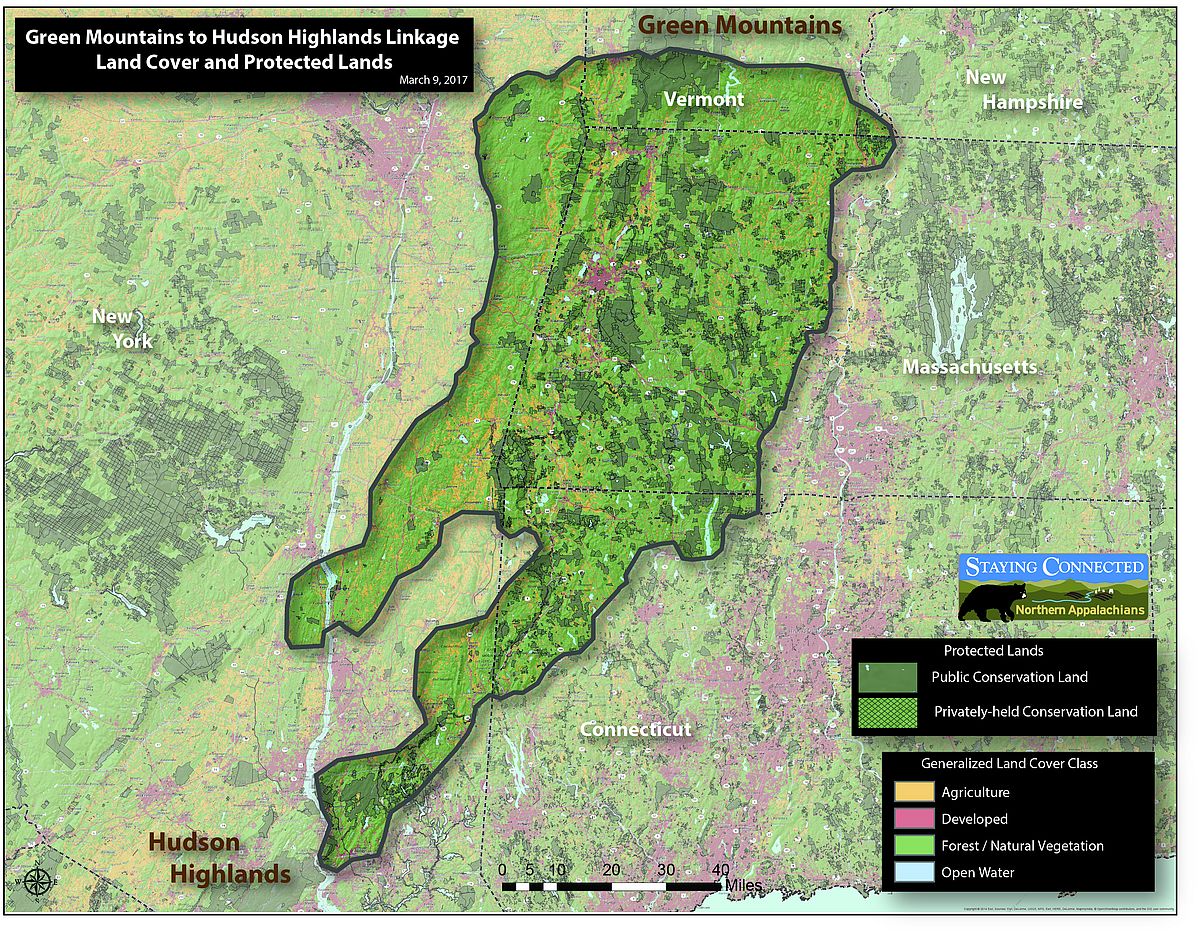
The Berkshire Wildlife Linkage isn’t a single park, hiking trail, or physical reserve you can visit. It is an abstract, 1.5-million-acre mapping boundary that links the forests of the Berkshire and Taconic Highlands north to the Green Mountains of Vermont and south to the Hudson Highlands. The Linkage sits within the northern range of the Appalachian Mountains, one of the most resilient, diverse and productive places on Earth, creating a connected corridor of habitat for wide-ranging species such as black bear, moose and bobcat, as well as many other important plants and animals. The Linkage has an estimated 75% forest cover and includes the most intact forest ecosystem in southern New England.
The initiative officially began in the winter of 2013–2014, when scientists from The Nature Conservancy strapped on snowshoes to ground-truth and map wildlife movement between the hilltowns of Western Massachusetts. They realized that the Berkshires risk becoming a series of fragmented “ecological islands” as human development expands. To prevent this, they partnered with the international Staying Connected Initiative to formally establish the Green Mountains-to-Hudson Highlands corridor—locally dubbed the Berkshire Wildlife Linkage.
The initiative functions through a silent coalition of partners—including The Nature Conservancy, the Massachusetts Department of Transportation, and local land trusts. Instead of one massive announcement, the work happens through decades of tiny, unglamorous projects: a 50-acre land donation here, a specialized wildlife culvert under a highway there. For example, the Massachusetts Department of Conservation and Recreation (DCR) recently finalized an acquisition to permanently absorb a 384-acre stretch of dense forest along the banks of the Farmington River. This tract of land represented a glaring, unprotected hole in an otherwise magnificent jigsaw puzzle of protected wildlife transportation, dividing two of the region’s great public wildernesses: the Sandisfield and Tolland State Forests.
To learn more about the Linkage and to get involved in the continued success of this crucial wildlife highway, visit The Nature Conservancy “How to Help” page.